Sunday, March 25, 2018

On "Pandering"

Hi team,

As you know, I've dedicated space in this blog to celebrating the increasing diversity of American cinema. 

It therefore perhaps comes as no surprise that I prickle when people dismiss movies that center characters who are not members of the dominant classes in America, meaning: anyone who is not white, straight, cis, male, presumed Christian (or at least not not Christian), and able-bodied.  The VAST majority of major American movies center characters who fit into this narrow demographic mold, even though that means excluding all but a minority of the population of this country.

This dismissal can be expressed through outrage, concocted controversies, and even whining over characters being played by actors with traits consistent with how the characters were written. Or it can be more subtle, perhaps packaged in a deeply fraught choice of words.  With a sigh, a furrowed brow, a shrug of the shoulders, or an irritated eye roll, these movies are at times described as "pandering".  I've heard this word used in reference to some of the most visible recent non-white-guy-centering movies, and it strikes me as exceedingly problematic.

Before we dive into what it means to use that word to describe these movies, let's start by defining our terms.  According to Merriam-Webster, the word "pandering" or "to pander" can be defined as:

to act as a panderespecially to provide gratification for others' desires 
  • films that pander to the basest emotions

to do or provide what someone wants or demands even though it is not proper, good, or reasonable

So from where I'm sitting: hooooooooly shit please tell me it's obvious that using this word to describe movies about people in oppressed minority groups is deeply problematic.  It's obvious, right?

In case it's not, let's unpack what's happening when we use the word "pandering" to describe

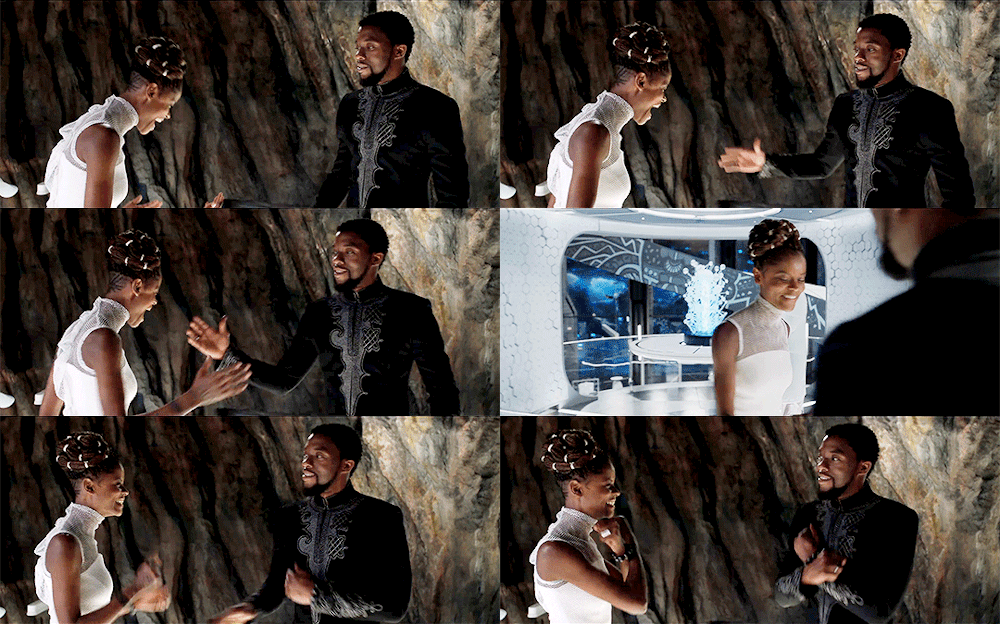
"Black Panther" (2018), 

or "Wonder Woman" (2017), 

or "Star Wars: The Force Awakens" (2015), 

or any movie that isn't only about white straight dudes.  Let's talk about what's happening if you've ever used that word for one of these films, or one like it.

First off, does that word even apply?

to act as a panderespecially to provide gratification for others' desires 
  • films that pander to the basest emotions


If we're saying this definition applies, we're implying that these films are created with the goal of gratifying "others' desires".  Well, who do we mean by "others", exactly?  "Wonder Woman", a movie centered around a female heroine, was directed by Patty Jenkins, who is a woman.  "Black Panther", a movie centered around a Black hero, was directed by Ryan Coogler, who is a Black man.  While many people have to cooperate for a movie to get made, if we consider that the person most readily identified as "in charge" of film projects is the director, we can't say that these films were made as a scheme to please "others" who are unlike the people in charge.  We could make the inference that it is the director's, not "others'", desires that are being gratified through these films.  These are movies made by women/Black people and about women/Black people.  Because pandering is by definition about providing for others', not your, desires, the word simply cannot apply in these cases; there are no "others" to be pandered to.

And what do we mean by "gratification of desires", and why is that inherently bad?  By "desires" being "gratified", are we insinuating that these films are only a manipulative ploy to grab at the ticket money of people too dumb to know that they're being "pandered" to?  Because that's pretty bleakly misanthropic.  Could we instead mean that the director's "desire" in these cases is to "for once make a movie that features characters with similar demographic traits to mine"? 

Sidenote: J.J. Abrams directed the white woman and Black man co-starred "Star Wars: The Force Awakens," and he's a white man.  So maybe we could say this definition applies for this film, but I'll address that later.

The exemplar given in that definition—"films that pander to the basest emotions"—I suppose could apply to these movies, if you interpret the simple wish to have someone who looks like you show up as a hero or even at all in movies every once in a while as an expression of profound self-centered narcissism.  But then, since the people calling these movies "pandering" often have similar demographic traits to those of basically EVER MOVIE HERO EVER, aren't you showing a bit of hypocrisy?  After all, you're basically saying, "Hey!  I like it better when literally 100% of the heroes look like me!!"  Who's having the self-centered "base emotions" now?


Now let's look at that second definition:

to do or provide what someone wants or demands even though it is not proper, good, or reasonable

Oof.

So: like many, I see the increasing emergence of diversity in cinema as a signal that our society is progressing by becoming more inclusive, tolerant, and embracing of people who are often overlooked or demeaned.  This is a particularly heartening trend in light of the current political reality in America.  It is also a necessary counterpoint to decades of (and still ongoing) problematic portrayals or erasures of people of color, women, LGBTQ people, members of non-Christian religions, and people of different ability levels and body types in American cinema.  There are so many people—the majority of Americans—waiting and fighting to be uplifted and seen as equal players in this country.

So if we say that diverse casting and stories are "pandering", we are suggesting that striving for more equitable and positive representation for members of oppressed minority groups is improper, bad, and unreasonable.  What worldview would support something so preposterous?

The answer to that question brings us to the real issue at hand: white supremacy and white privilege.

From this excellent Facebook page based on one of my favorite 90s shows!

If you feel a pull to call a non-white-dude-centric film "pandering", that is an expression of the very disconcerting fact that you see anyone not superficially resembling you—because of gender, color, sexual orientation, physical ability, body type, what have you—as less than you. It expresses your failure to see those people as, like you, just people.  It is an indictment of your own lack of ability to recognize the humanity in others who do not look like you. 

That failure might not be in your full, conscious awareness.  It may be in conflict with your values or the kind of person you want to be.  Regardless, in calling these films “pandering”, you are naming your blindness to the humanity of your fellow human beings, and you are participating in their oppression by supporting their continued erasure.  You are saying, in essence, that these films should not be made because they are somehow beneath us.


You are also expressing your privilege. Because odds are, calling a non-white-person-focused movie “pandering” is a not-fully-conscious recognition that you are used to—and prefer—seeing yourself reflected in everything everywhere you go.  This white person's monopoly on representation is comforting, because it reinforces the fact that the world has mostly been organized around your comfort.  It is comforting to constantly be shown evidence the world is about and for you. 

It is therefore uncomfortable to be shown that there are other people.  This means that maybe the world isn’t only about you anymore, and that space is being made for others to also have comfort.  To need to put down those still extraordinarily rare corrective films as “pandering” is an attempt to reclaim 100% of the comfort for yourself.  Well pardon me, but fuck you.

You and me both, Clarissa.

Because here’s the thing: I’m not Black.  There are no white women in “Black Panther”. On a demographic basis, I have no placeholder in the film.  But as a human being, watching that movie made my heart sing with joy.  I know how much intentional positive representation matters, and how far we have yet to go as a nation in creating that for everyone.  In "Black Panther", I saw a critical step in that corrective process.  I saw my fellow human beings being celebrated.  I could imagine the uplifting force of that movie for thousands upon thousands of my Black fellow human beings.  I could see its capacity to heal and empower after generations of oppression.  How could I not gratefully embrace this film?

And how could I not speak up when I hear it dismissed?

Seriously, look at these children’s faces as they watch "Black Panther".  Listen to their reactions to that movie.


Look, listen, and ask yourself: Are those the faces of children who are being “pandered” to? 

You would say that movie shouldn't have been made?  You would deny those children the chance to see themselves as powerful, valuable, capable, and as deserving of our attention—yes, your attention?

A movie does not need to be about me or you to be a source of exhilaration, inspiration, and happiness.  We can recognize that a rising tide of inclusion uplifts us all—and that we cannot be free while any one of us is unfree.  We can see the good, communal value in another person’s story.  We can have gratitude for being given a seat at the table where others’ stories are told.

There’s a seat for you, too.

If you don’t take it, your loss—of the opportunity to expand your curiosity about, compassion for, and experience of the common humanity of your fellow human beings.

I sincerely hope you join us.

{Heart}

Sunday, March 11, 2018

Congratulations Jordan Peele!!

Hi everyone,

I want to wish a deeply heartfelt CONGRATULATIONS to Jordan Peele for a much-deserved, historic Oscar win for best original screenplay for "Get Out"!


If you weren't able to catch his acceptance speech, you can watch it here (with a backing track of Laverne Cox's enthusiastic response because she and everyone else were so excited about this win!).  Make sure you catch Mr. Peele's wonderfully astonished reaction as he leaves the stage!

Mr. Peele with his long-time collaborator, Keegan-Michael Key.
Mr. Peele is the fourth African American to be nominated in the category of best original screenplay.  (Sidenote: HOW did Spike Lee not win for "Do the Right Thing" (1989)???!)  Together with other encouraging developments in the recent Academy Awards ceremonies, let's hope this signals a more consistent uplifting of the art and talents of people of color in the film industry.

Hurray!

{Heart}

Wednesday, February 28, 2018

Snap Judgment: "Black Panther"

Guys,

Perhaps you've heard all the excitement about Marvel's "Black Panther" (2018)?


Well I'm here to exuberantly and unambiguously pile on with 2018's first Snap Judgment!

Let's roll!

  • It is visually stunning, and it is thrilling.  

"Black Panther" is a visual feast.  The set and costume design, makeup and hair are exquisite.  Gorgeous African landscapes break into the triumphant futuristic skyscrapers of Wakanda.  The costuming is vibrant and at times highly architectural.  The hair styling is a beautiful celebration of Black women's hair.  It is an absolute joy seeing this movie on a big screen.


While action doesn't over-dominate the narrative of "Black Panther," this is an absolute strength of the film.  It makes room for the rich and thoughtful substance of the movie while still allocating time for excellent action.  The action and fight sequences alternate between nail-biting death matches with stakes that feel very real and exhilarating demonstrations of Wakandans' innovative and formidable prowess in combat.

  • Superheroes have finally figured out equitable power between the sexes

One of the very many bracingly enjoyable things about "Black Panther" is that it is a movie that lives fully in the recognition that men and women can be equally powerful without having to compromise on their power.  Women don't apologize for their power.  Men don't resent women for their power. 


In one fight sequence, Danai Gurira's Okoye mirrors Chadwick Boseman's Black Panther stance mounted atop speeding cars as they race in pursuit of their shared enemy, each vehicle being driven by their women compatriots: Lupita Nyong'o's Nakia is barefoot, having lost her shoes when she used them as weapons in an earlier grappling match, and Letitia Wright's Shuri, who commandeers the Panther's vehicular escort remotely using technology she has perfected.  Incredible action ensues!


Power manifests not just in ability to fight with equal skillfulness, but also through other skills.  During an interlude in Busan, Nakia slides seamlessly into Korean, with Boseman's T'Challa and Okoye clearly following along, demonstrating that everyone in Wakanda is at minimum trilingual.  Later, Martin Freeman's Agent Ross obnoxiously inquires of T'Challa, "Does she speak English?", referring to the standing-right-there Okoye.  Rather than answering for her T'Challa lets Okoye intervene on her own behalf, responding assertively in the affirmative by clarifying in the third person and in English, "When she wants to."

  • DANAI GURIRA ALL DAY EVERY DAY

This brings me to the fact that DANAI GURIRA IS MY FAVORITE.  I have loved her since my days watching "The Walking Dead," in which she is the katana-wielding stoic queen of badassery Michonne.


She is no less show-stopping in "Black Panther" as she wields a spear imbued with the power and technology of Wakanda's precious natural resource, vibranium.  In one of my favorite fight sequences, she is a vision of lethal beauty as she relentlessly pursues her adversary, leaping from a balcony to the floor below her, the train of her vivid red dress flowing like flame behind her.  She is glorious power.


I am so thrilled to see Gurira in an excellent role as General Okoye, the head of King T'Challa's royal guard.  She imbues fearsome strength and skillfulness with compelling affect, as Okoye is torn between her dedication to her duties as a defender of the Wakandan king and, for example, her love for her partner, Daniel Kaluuya's W'Kabi.  She weaves warmth and humor into what could be a two-dimensional character in less competent hands.

  • It is inspiring, and it is needed.

The desperate need for this and other movies like it is written on the faces of Black children watching "Black Panther" and in the enthusiasm of fans that preceded its release.  As a white person and for my white readers, it might not be possible to fully appreciate how deeply uplifting and corrective this movie is for our Black neighbors.


Angela Bassett, who plays Ramonda with gravitas, strength, and dignity, expands on the history behind and necessity for films like "Black Panther":


  • It is thought-provoking, and it is correct.

Warning: Spoilers ahoy!

The main threat to Wakanda arrives in the form of T'Challa's long-lost cousin Erik.  The parallel lives of T'Challa and Erik, later known by his villainous moniker "Killmonger," assert an important truth: when you raise children in an environment that uplifts them, in a healthy environment with resources and support, in a joyful environment that celebrates them and their heritage, they are capable of greatness--even of being a king.


By comparison, when you raise children not only in a toxic environment in which they are "over-policed and incarcerated," as Sterling K. Brown's N'Jobu asserts, but also in a society that fears and reviles them, in communities that are under-supported in combatting poverty, crime, and illness and in which schools are under-funded, where as citizens they are preyed on by exploitive banks, kept in housing that is literally toxic as a result of generations of redlining, and kept from jobs due to internalized racism, where connection to their heritage was violently denied them because of this nation's participation in slavery, and their culture is either stigmatized or appropriated and profited from by an at best fickle, blissfully ignorant, and indifferent dominant culture, is it any wonder that potential greatness contorts into desperation and rage?  Is it any wonder that there might be a wish to inflict that desperate rage on the world in order to upend the status quo of oppression?

Inflicted with a grievous but potentially recoverable wound, Erik chooses to die, asking of T'Challa, "Bury me in the ocean with my ancestors who jumped from the ships because they knew death is better than bondage."  He gutwrenchingly summarizes the impossible choices we have reserved for many citizens in communities of color.  There is no other way to interpret Erik's transformation into Killmonger as anything other than the direct byproduct of the havoc America's racist history and present has wrought on Black communities.

But this brings me to an important thing about "Black Panther": it isn't first and foremost about or for white people.  It is substantive, exhilarating, beautiful, and SO MUCH FUN for anyone lucky enough to see it, but it's not primarily for white people.  This is why it, like so many incredibly exciting movies recently reaching a broader audience while firmly centering people of color, it is so happily welcome.

The central cause of the conflict between T'Challa and Erik is Wakanda's inaction in the face of the suffering of people of African heritage in many parts of the world.  Wakanda has immense resources and knowledge to offer, but remains in self-imposed isolation to protect itself from possible degradation of its arguably near-utopian way of life and attempts to pilfer its riches.

As the film comes to a close, King T'Challa speaks to an audience at the United Nations.  Moved by the conflict with his cousin, T'Challa announces that Wakanda will end its policy of isolation and will now share its resources with the world.  A UN delegate attempts to smugly dismiss the offer, asking, "What does a nation of farmers have to offer the world?"  The film closes on T'Challa's confident and knowing smile, because he knows what we now know.


This brings us to perhaps the most important message of "Black Panther": People of African descent, symbolized in the people of Wakanda, have immense resources to offer the world.  They always have.  The shields blinding the outside world to their knowledge, innovation, and resilience are likely the product of a Eurocentric view of history, ignorance, and/or racism rather than a vibranium-fueled holographic barrier hidden in the heart of the African continent, yet that greatness exists, persists, and increasingly thrives.  Wakanda may not exist in reality, but the corrective power of "Black Panther" and the stories like it to come will help to further liberate that greatness.  We will all be so much better for it.

Needless to say, I gave "Black Panther" a 5.  Go see it!!

{Heart}

Sunday, January 28, 2018

2017 Movie Round-Up!!

Hello!!

It's the most magical time of the year: time for the annual movie round-up!!


This is a particularly happy occasion because:

a) I am pleased with myself for writing this post before the end of January, because one of my resolutions for 2018 is to write at least a teeny bit more often than last year, and

b) because I watched extra movies last year and that makes me happy!

Without further ado: 


The PsychoCinematic Year in Movies
2017 Edition

2. Arrival (5)
3. Asperger's Are Us (3.5)
4. Wishful Drinking (4)
5. Captivated: The Trials of Pamela Smart (4.5)
6. Hidden Figures (4.5)
7. I Am Not Your Negro (5)
8. Glory Daze: The Life and Times of Michael Alig (4)
9. My Friend Rockefeller (3.5)
10. Get Out (5)
11. Kedi (5)
13. Paradise Lost: The Child Murders at Robin Hood Hills (4)
14. The Innocents (5)
15. Frantz (2)
16. I Called Him Morgan (5)
17. Under the Shadow (4)
18. Guardians of the Galaxy Volume 2 (4)
19. Casting Jon-Benet (3.5)
21. Wonder Woman (4)
23. The Lego Batman Movie (4)
25. The Big Sick (4.5)
26. Looper (5)
27. The Beguiled (2)
29. The B-Side: Elsa Dorfman's Portrait Photography (4)
30. Step (5)
31. Dunkirk (3)
32. Monkey Business: The Adventures of Curious George's Creators (4.5)
33. Wind River (3.5)
34. Paris is Burning (5)
36. Accidental Courtesy: Daryl Davis, Race and America (5)
37. Masterminds (1.5)
38. Rough Night (3)
39. The Little Hours (2.5)
40. Battle of the Sexes (4)
41. Lucky (3.5)
42. It (4.5)
44. Blade Runner 2049 (4)
46. Thor Ragnarok (3)
47. One of Us (4)
48. The Look of Silence (5)
49. Oklahoma City (4.5)
50. Loving Vincent (4)
51. Lady Bird (5)
52. Three Billboards outside Ebbing, Missouri (4)
53. The Rise and Rise of Bitcoin (2)
54. The Disaster Artist (5)*
55. The Shape of Water (4)
56. 32 Pills: My Sister's Suicide (4)
57. Star Wars: The Last Jedi (5)

That's right: 5 whole extra movies!!


One nice pattern over the course of 2017 is that I kept up a pretty consistent pace in my movie-watching throughout.  I was further enabled in my movie consumption by finally putting into place some quality-of-life-enhancing limits on work, which had the desired effect of giving me more time to do things that matter to me and more space to feel in balance.  Yay!!

So let's start off by taking a look at the sub-optimal movies I saw in 2017:

For having a lot of potential to be interesting 
but ultimately being about a self-pitying murderer/coward rich guy, which: NOPE:
Frantz (2016)

For creating the cringeyest flute scene imaginable:

For drowning in toxic masculinity and also 
for completely erasing the existence of enslaved men and women in the context of the Civil War 
and instead centering on the plight of white women making dumb decisions??, 
or more succinctly: For super problematic white feminism:
The Beguiled (2017)

For being the kind of film about which my most glowing praise includes 
"It is a movie that exists," and "It is short":
Masterminds (2016)

For blunt force boringness:
The Rise and Rise of Bitcoin (2014)

In some ways I'm oddly disappointed to have so few entries in this category this year.  It can be entertaining to hate on movies that were particularly bad.  On the other hand, it feels kind of ridiculous to be unhappy I was fortunate enough to see many movies I really enjoyed.  Obviously this is in most ways the best outcome in reflecting on a year of viewership.

This year, I'm inclined to make my choice based on the egregiousness of the not-greatness.  This year's choice for worst movie had a great cast.  Its director previously created a movie I enjoyed (and that has a pretty solid, atmospheric soundtrack).  And it exists in ignorance of the question, "Can we seriously please work on our intersectional allyship and not make white people the center of everything especially when it's really inappropriate??"


The worst movie I saw in 2017 was therefore:


And next!

Compared to the number of not-so-great movies, I had the exact opposite problem in 2017: SO MANY GOOD MOVIES.

NO.

TOO MANY GOOD MOVIES.


It actually is really exciting to have this level of challenge in choosing the best movie of the year!  The best-rated movies I watched in 2017 were:

Arrival (2016)
Captivated: The Trials of Pamela Smart (2014)
Hidden Figures (2016)
I Am Not Your Negro (2016)
The Innocents (2016)
I Called Him Morgan (2016)
Step (2017)
Monkey Business: The Adventures of Curious George's Creators (2017)
Paris is Burning (1990)
Accidental Courtesy: Daryl Davis, Race and America (2016)
The Look of Silence (2014)
Oklahoma City (2017)
Lady Bird (2017)
Star Wars: The Last Jedi (2017)

In looking at this list, one pattern that emerges is the incidence of true-crime related documentaries like "There's Something Wrong with Aunt Diane," "Mommy Dead and Dearest," "Captivated: The Trials of Pamela Smart," "Oklahoma City," and "I Called Him Morgan" (although this last film is much broader than to only focus on the death of legendary jazz trumpeter Lee Morgan).  "The Look of Silence" is a particularly impactful entry in this sub-category of the year's great movies, as through the lens of one man's brave confrontations of the perpetrators of his brother's brutal murder, the film's sweeping scope encompasses the Indonesian genocide of the 1960s.

There are also entries that testify to inspiring lady badassery.  "The Innocents" tells the chilling and complex true story of a convent of Polish nuns who were sexually assaulted by Russian soldiers and the French woman doctor who came to their aid.  The latest "Star Wars" is a testament to the compelling power of a young woman jedi surrounded by a diverse cast packed with commanding women and people of color.  "Monkey Business: The Adventures of Curious George's Creators" tells the surprising story of the couple who created Curious George, including their harrowing escape from Nazi-invaded Paris by bicycle, and Margret Rey's formidable dedication to keeping her husband's legacy alive (it also happens to feature work by two awesome friends of mine).  "Hidden Figures" uplifts the brilliance, resilience, and self-determination of the Black women who made major NASA missions possible.

* This list unfortunately includes an entry that is now clearly problematic due to the involvement of James Franco, who has been accused of sexual misconduct.  I learned of these allegations after seeing "The Disaster Artist."  It really sucks when great projects are tarnished by the unacceptable and avoidable exploitive misbehavior of the people involved.  It of course sucks way more that this behavior impacts their colleagues and can destroy the careers of people who deserved to work unexploited.  The good news: there are so many other movies to see and voices to be heard and we as audience members and ticket-buyers can make ever more informed choices.

And here is where I've gotten stuck over and over again in making my decision.  I think I'm ready to make my choice, but first I want to highlight some very close competitors:


"Step" is a deeply compelling, heart-gripping documentary about young women in Baltimore brought together through their high school's step team.  As the first graduating class at their all-girls charter school, the pressure is on for each portrayed team member to make it into college despite the significant barriers presented by poverty.  It is a beautiful and clear-eyed portrait of the city of Baltimore as well as the young people boldly fighting to make better lives for themselves.


You may already know my feelings about "Kedi."  Honesty time: I cried just watching the trailer for this movie.  I am perhaps too invested in cats.  I was already so moved by the gorgeous footage of street cats in Istanbul that I had no idea what a deeper and soul-soothing gift this film would be because of the testimonials of the custodians of the portrayed animals.  It is such a beautiful portrayal of compassionate, care-taking masculinity and therefore a film this world desperately needs.

My favorite movie of 2017, however, is a film I deeply wish every American would see.  It gives an incisive overview of the history and current state of race relations in America and is therefore an excellent and critical primer for anyone wishing to understand better the ongoing legacy and impact of racism in this nation.  It is not an easy film, but it is a necessary film.

My favorite movie of 2017 is:


Looking forward to another year of great movies with you, friends.

{Heart}


PS: Here's one of my favorite clips of James Baldwin from "I Am Not Your Negro."  It's a great concise argument to have in your back pocket (or handy on your cell phone) for any time someone tries to say racism doesn't exist in America.

Sunday, January 7, 2018

Closing 2017: Resolutions Edition

Happy New Year Dear Friends and Readers!

Welcome to a new and hopefully less terrible year!

It's time for our annual review of resolutions and to update goals for the coming year.  In the grand tradition of choosing a theme for posts like these, I've decided that this year I will feature yet another one of the world's wonderful animals and one of my personal favorites: the octopus.


I've loved octopi for many years now, beginning with an encounter with a little octopus while on vacation with my family in Mexico when I was a child.  They're beautiful, weird, and incredibly intelligent creatures, as evidenced by this particularly delightful footage of octopi using coconut shells for protection:


So now, escorted by our octopus chaperones: Shall we? 


We shall.

My goals for 2017 were:

1. Regularly smash the patriarchy.

As operationalized by:

--Participate in regular direct advocacy with my elected officials.

As I noted in my midyear resolutions update, these two apps have been a major game-changer in increasing the feasibility and regularity of my outreach to elected officials.  I could absolutely stand to communicate more, but the extent to which I've been able to engage in regular advocacy with my elected officials is almost exclusively due to these innovative tools.

--Set up recurring donations to advocacy organizations that will protect causes that are important to me, including civil rights and preservation of other democratic values like freedom of speech, assembly, and press.

I continue to be so glad Husband and I are finally in a position to do this and that we have.  I'm planning for this to be something we continue.  Our monthly donations are small, which means they are feasible for us but also hopefully that they make a cumulative positive impact for causes we care about.


--Ongoing self-education through self-directed reading and, ideally, participation in courses to learn about dismantling systemic discrimination.

Thanks to a local anti-racism collaborative, I got to participate in a really enriching six week seminar dedicated to dismantling systemic racism.  The seminar included fruitful discussions about the manifestations of racism in American society and made space for practical discussions of strategies for directly addressing racism when it is expressed in interactions with others.  I'm really grateful resources like these are available in my community and highly recommend participating in trainings and seminars like this to anyone who is interested in being a force for good by advocating more effectively against racism.

Outside of this seminar, I could be much better about dedicating more time to self-directed learning in this domain.  I do this periodically through watching documentaries and reading books and articles, but I would like to do this more regularly.


--Advocacy, conversation, and education with colleagues to ensure they feel empowered to stand up for the vulnerable communities we serve as expert, ethical practitioners.

Due to the recent changes I've made at work, I haven't had as many opportunities to do this with colleagues.  However, my hope is to attempt multicultural seminar 2.0 in the new year--I just need to take the initiative to make it happen.  Seminar 1.0 gave me a small taste of the challenges of launching these conversations in a professional sphere, and I think it'll be important for me to work through those differently the second time around.

I've had the occasional conversation with friends and family about the anti-racism training I did and my overall interest in anti-racism, though that's something I could surely expand on.

--Practicing my right to peacefully assemble and demonstrate.

As I noted in my last post, this is something I un/happily had many occasions to act on: unhappily because so very many protestable things have happened in the last year, happily because

a) we still have the right to peacefully demonstrate, and

--Regularly consume news media again.

Still working on this one.  I was keeping up with NPR's 5-minute morning news bulletin for a while, but I've decided to forgo that for reasons I'll elaborate on below.  I still feel committed to this goal, but I have to figure out how to make it happen.


2. Learn all the stuff and things.

There are several ways in which I've been lucky to be able to do this.  One is through a book club I joined after moving to New City, which has kept extra pressure on me to read often and has prompted me to read work I've really enjoyed.  I've also learned a ton of practical professional knowledge since moving into a new role at work, which I'm really grateful for.  I have some thoughts on how to continue this goal in the new year, which I'll expand on below.  

I was, albeit temporarily, successful in practicing Swedish regularly in anticipation of the really incredible trip abroad Husband and I took a few months ago.  I then didn't really have the occasion to use anything I learned because it appears all Swedish people speak impeccable English.  Experiencing the opposite of my unnecessary pre-trip urgency upon our return, I promptly stopped practicing.  I'd still like to keep poking along with that learning, though, so I'm hoping to recommence it in the New Year.

3. Find ways to meaningfully and consistently set limits with work.

Yeeeeaaaahhhhhh!!!  Guys!!!  I really actually did it this year!  

It took a lot of time, struggle, and ironically ever more work before it could happen, but I did the thing.  

Me in the midst of the STRUGGLE to actually do the limit-setting thing. 
It's been a massive blessing in so many ways and was a direct byproduct of the supportive and concerted pushes I've gotten from several trusted friends, colleagues, and family members.  I'm grateful to have their help in breaking my untenable habits of overwork and am hoping I can maintain this better balance.

4. Write more.

I just barely squeaked by with one more post than the previous two years, and (to the immense satisfaction of my minor perfectionist streak) wrote at least one post for every month of the year!

I've continued to write in a journal, too, although the fact that I'm still using the same one as I was at the beginning of the last New Year demonstrates that my pace has slowed somewhat.  Writing every day is probably not sustainable, but I'm very glad to have even a semi-regular practice  of writing and reflection back in my life not least because it was yet another driver behind making the changes required at work this year.

5. Watch at least 52 movies.


Yusssssssss!!  I DID THE THING.  Much to my joy and pleasure, I watched 5 movies in excess of my goal this year--yet another accomplishment linked to limit-setting with work (because when you set limits with work, you have free time to watch movies!)!

In looking back at these goals and reflecting on how each of them went, I'm happy that I managed to set goals that were realistic yet still reaches.  I didn't perfectly accomplish these goals, but I'm glad to see the opportunities for growth those imperfections illuminate.  So without further ado, let's look ahead to this year's goals!

I just can't get enough of this coconut action.
Spoiler alert: There'll be some repeats, but also one or two new ones.

1. Regularly smash the patriarchy.

To maintain rigorous adherence to this goal but also condense things a bit, I'll update what I mean by this by narrowing it to the things I still need to work on and setting clearer expectations for myself: 

--Participate in at least once weekly advocacy with my elected officials.
--Ongoing self-education through self-directed reading, participation in at least one course to learn about dismantling systemic discrimination, and joining an ongoing anti-racist action group
--Lead a second round of the multicultural seminar at work.
--Practice my right to peacefully assemble and demonstrate at least 3 times this year.
--Regularly consume news media again.

It's really only this last one that'll be a challenge, largely because the window I had in my routine for regularly doing this has now be re-allocated in the service of another goal.  Maybe I could listen to a news summary after I get home from work?  Surely I can find five minutes for this.  I'll just have to decide when to make it happen.

2. Learn all the stuff and things.

I'm often annoyed with how much time I spend idling around on my phone, and I would like to do a better job of more regularly either a) putting my phone down and reading a book instead, or b) using phone time to read the gigantic backlog of articles I've bookmarked to read later.  I'm also aware of the ways in which phone idling can be a genuine form of self-regulation and self-soothing for me, so I'm not looking to get overzealous with this--sometimes it's okay to need to just tune out and/or be diverted.  But let's be real, I could have easily read more and cut back a bit on my Insta time.


3. Write more: keep journaling and 15 posts!

I absolutely want to keep up with journaling at least 3 times a month (ideally more), and I'd love to top last year's total number of posts by *just* one, if not a few more.

4. Actively prepare and take steps to build the life I want.

One of the very best benefits of setting limits with work has been that it has created the mental, emotional, and physical space required for me to be able to think about the big picture of my life and what I want my next steps to be.  I could not be more grateful for the clarity this space has afforded me, and I'm really excited about the plans Husband and I are concocting.

I'm not meaning to be overly cryptic, as I'll be very glad to share more specifically what I mean when the time is right.  In the meantime, there's a lot more work to be done and I'm excited to do that work.


5. Cultivate compassion.

As I perhaps unclearly alluded to in my last post, I'm wanting to practice taking a more balanced perspective.  What I really mean by that is that is that I want to be more patient and less irritable with people in general.

One of the debates that emerged after the presidential election was the debate over whether we needed to have compassion for those who made the catastrophic decision to support our current president.  My attitude, perhaps unsurprisingly, has been that I am WAY more concerned with dedicating my brain space and energy to supporting the people who are legitimately under threat because of this presidency than the people who made that threat a reality.  Frankly, I have concerns that worrying about the feelings of the president's supporters continues to center the feelings of members of the cultural majority (white Christian-identified straight people--of course not all of whom supported the president) over the feelings of every other ethnic, racial, religious, sexual, and gender minority, despite the clear fact that the members of those latter groups are the people most likely to be victimized by the president's policies and behaviors.  In short, it's yet another manifestation of white supremacy.

I still maintain this stance.  That being said, in the immediate aftermath of the white supremacist terror and violence in Charlottesville, I went to an amazing training for anti-racist demonstrators before a major anti-racist demonstration in New City.  The leader of this training was an incredible, brave, principled, and talented photojournalist who had been in Charlottesville with faith leaders heading the counter-demonstrations.  She told us that threats had been made against the faith leaders by white supremacists, and that they and she had genuinely feared for their lives to the point of writing farewell letters to their loved ones the night before the violence turned fatal, leading to the death of a counter-demonstrator.  Hearing her story filled me with grief and rage at the state of our nation and the ugly audacity of bigots so deluded they would threaten men and women of faith.

However: the intention behind this training was to support us in finding our center so we could advocate against oppression from solid ground.  Not from a place of anger, sadness, and fear.  Instead, from a place of deep abiding love.

This doesn't have to mean having love for practitioners of hate, although it can mean having love for the broken, miserable ember of humanity that may still someday redeem them.  More easily, it can mean having love for the precious, hateless future for which you demonstrate and it can mean having love for the people you wish to uplift.

So, to be a better person, psychologist, advocate, and ally, I want to cultivate within myself more deep, abiding love.  The best way I know how to do that is through loving-kindness meditation.  For those of you unfamiliar with this practice, it's a meditative practice centered around building compassion, warmth, and love for yourself and others, usually through contemplating four mantras like those listed below:


I've started practicing this for a few minutes each day and choosing different living things to send this energy to, and I'm hoping that over time this practice will help me stay in better contact with the deep, abiding love I have to offer.

6. Watch at least 52 movies.

Finally, our oldie but goodie.  A toast to another year of great movies!

And!


{Heart}