Sunday, February 20, 2022

Antiracist Accountability Post: Comedy x Olympics Mashup

Happy Sunday friends!

Recent events have created a happy opportunity for a transaction between past antiracist accountability posts, leading to today's mashup!

One of the comics I highlighted in last month's accountability post, Erin Jackson, has a great bit on her album "Grudgery" (2018) about googling her own name to ensure that she is in good standing among the Erin Jacksons of the world.  She has historically been reassured that other newsworthy Erin Jacksons are no threat to her comparative success, until a rival Erin Jackson apparently discovered she was good at speed skating.

The bit is super entertaining, as Jackson's album-titling grudginess is in full effect.  You can listen to it here:

And here's where last month's post transacts with last year's post about the Olympics, putting this sporting event at least for a moment in a more positive light than the subject of my previous post: 

Perhaps to Ms. Jackson's chagrin, the latter Ms. Jackson had a pretty busy day at the Olympics a few days ago, becoming the first Black woman to win an individual gold medal at the Winter Olympics, as well as the first American woman to win a gold medal in speed skating since 1994.

Yay!

For all her typical saltiness, the former Ms. Jackson appears to be taking it well.


A hearty congratulations to both Erin Jacksons, the one for an extremely impressive accomplishment on the world stage, and the other for a whole bunch of new content to turn into comedy gold.

{Heart}

Tuesday, February 15, 2022

2021 Movie Round-Up!!

Hi team,

It's that glorious time of the year (which sometimes occurs in February) where we look back on the previous year of films!  I'm looking forward to reflecting on the movies I watched last year.

Without further ado, I present:

The PsychoCinematic Year in Movies
2021 Edition

1. Safety Not Guaranteed (4)
2. Drinking Buddies (1)
3. The Gentlemen (4)
4. The Trial of the Chicago 7 (4.5)
7. Emma. (2)
8. Stranger than Fiction (4)***
9. Framing Britney Spears (4)
10. The Two Killings of Sam Cooke (4)
12. Roman Holiday (4)
13. I Care A Lot (1)
15. Ma Rainey’s Black Bottom (5)
21. She’s Gotta Have It (5)
23. The Lovebirds (3)
24. Being Canadian (2)
27. Meet the Parents (3)***
28. Four Weddings and a Funeral (3.5)
29. Hamlet 2 (2)
30. Knocked Up (2.5)***
31. The Forty-Year-Old Version (4)
32. Meet the Fockers (3)***
34. Rounders (2)
35. The People vs Larry Flynt (3)
36. The Hangover (4)***
37. Breathless (4)***
38. Bob Ross: Happy Accidents, Betrayal & Greed (3)**
39. Black Narcissus (3.5)
40. Cars (2)
41. The Nun (1)
42. Badlands (2)
43. Annabelle: Creation (2)
44. Winchester (4)
45. Annabelle (1)
46. The Addams Family (3)
48. The Eyes of Tammy Faye (4)
49. Dune (4.5)
50. Love Hard (3)
51. Office Christmas Party (3.5)
52. Deck the Halls (2)
53. Klaus (5)
54. Matrix Resurrections (2)

A quick reminder of the meaning behind the various annotations used throughout the list:

* = got nauseated
** = fell asleep
*** = rewatch

Thankfully, I didn't watch any movies last year that required the notation resulting from making me queasy.  I definitely took ample advantage of my accommodation from recent years that allows me to count movies I've seen before.

As you can see, as a stark contrast to last year's list that came within a hair's breadth of being 100 movies long, I only ever so slightly exceeded my annual 52 movies goal in 2021.  While I don't love that I cut it so close last year, on the other hand I was overall pretty consistent in watching about a movie a week throughout the year, which seems like evidence of a fairly bankable, consistent approach to doing something I enjoy.

Another thing that strikes me is the relatively slim pickings for favorite movie of the year, which bums me out and confuses me, especially when the list of highly rated movies last year was exceptionally long.  I'm not sure what led to so many middling ratings on last year's list.  It could be that my overall dulled emotional state suppressed my otherwise at times generous ratings.  It's possible, for similar reasons, that I simply wasn't up for the kinds of movies I tend to rate highly because those movies often earn their 5/5 at least in part by being emotionally evocative, and I tended instead to watch movies that would be fine but not terribly emotionally stimulating--a thing I have a history of doing.  It's possible that last year was just a weird year for movies, and that the bait I took from various streaming service algorithms wasn't that great.  

The fact that several of the highest rated movies are films I'd watched before only adds to my concern.  Was I letting myself lapse into a movie "safe zone" in which most of the good movies I watched were known quantities because I didn't feel like I could tolerate anything new and potentially emotionally challenging?  I don't like that possibility at all.

Thankfully, watching "The French Dispatch" (2021) at the beginning of this year may have been a corrective example to this possible trend, hopefully setting the precedent that my viewing selections this year are braver and more illustrative of my resilience (and that resilience actually exists, largely because I consistently work to maintain it).

With all that in mind, let's transition into the first major consideration of this retrospective: my least favorite film of last year.

For being included in a list of great comedies but being in actuality not even remotely funny, being packed with pretty irredeemable AND boring people, and for woefully underutilizing Olivia Wilde:
Drinking Buddies (2013)

For portraying workers in elder care as evil early/mid-pandemic and then getting incomprehensibly confused about whether its main character was a villain or a hero:
I Care A Lot (2020)

For having no business being as boring and silly as it was given the rich opportunities 
afforded by its premise:
The Nun (2018)

For being deeply unpleasant and tedious, and also for by its very existence insisting that there need to be multiple movies about a creepy doll in one scary movie franchise when, in fact, no there do not:
Annabelle (2014)

It's interesting to note that, like the highly rated movies of 2021, last year's field of truly awful movies is also somewhat smaller than usual.  I guess there was an overall narrowing of my ratings at the extremes, and that's not all bad.

Honestly, I have just about equivalent feelings of hatred for each of these movies despite the fact that the reasons for my displeasure differ.  However, one does rise to the top (or rather, sink to the bottom) because it is not only bad--with a messy and illogical plot and an incredibly unsatisfying ending--it is also harmful in its messaging.

My least favorite movie from 2021 was therefore:

I Care A Lot (2020)

Yeah that movie was just terrible.

And now, moving on to the good stuff!

The highest rated movies I watched last year were:

The Trial of the Chicago 7 (2020)
Booksmart (2019)***
The Big Short (2015)***
Ma Rainey’s Black Bottom (2020)
She’s Gotta Have It (1986)
22 Jump Street (2014)***
The Inventor: Out for Blood in Silicon Valley (2019)***
Dune (2021)
Klaus (2019)

While I really appreciate the films I rewatched and re-liked this year, it doesn't seem fair to put them in a positive double jeopardy situation when they've already been up for Favorite Movie of the Year contention in previous years.  Therefore, while I continue to love "Booksmart" (2015), "The Big Short" (2015), "22 Jump Street" (2014), and "The Inventor" (2019), I am ruling them out of contention for this year.

That leaves us with another surprisingly narrow field of only five contenders.

While I think "The Trial of the Chicago 7" (2020) was a generally compelling retelling of an important chapter in American activist history, its 4.5 rating highlights that it had its imperfections, including unconscionably  downgrading the abuses to which Bobby Seale was subjected by Judge Julius Hoffman and making some weirdly emotionally discordant soundtrack choices at its opening.

I thought "Dune" (2021) was excellent in most ways, including its gorgeous imagery, brooding soundtrack, and strong performances, but again its 4.5 rating means that it just barely misses the mark for consideration.

"Ma Rainey's Black Bottom" (2020) is a wonderful performance of August Wilson's play, featuring most memorably Chadwick Boseman in his final performance before his death but also a formidably transformed Viola Davis as the titular Ma Rainey.  Boseman's final monologue as Levee Green overflows with the aching anguish of Boseman's impending death, imbuing Green's anticipation of a different kind of inevitable, crushing doom with ever more fragility and gutwrenching heartbreak.  Despite the eternal risks inherent in translating a play to the screen, "Ma Rainey's" pulls off the transition gracefully.  Frankly, during an era in which it's harder to access live theater, the fleeting moments that do feel stagey actually feel like a balm--what a gift to imagine being in the audience while these actors say Wilson's words.

2019's "Klaus" took me very pleasantly by surprise this past holiday season, to the point that it has prompted me to hopefully start writing a medley of holiday movies similar to my annual Halloween showcase.  It is a beautiful, whimsical, poignant, and sincerely funny secular (though still appropriately magical as becoming the season) telling of the origins of Santa Claus.

And then we have "She's Gotta Have It" (1986).  We already know I'm a sucker for Spike Lee movies, and this one readily falls into that trend.  I am grateful to have watched this film this year.  Its clear standing in the history of film excited the film studies part of my brain on top of being absolutely beautifully shot and packed with wonderful performances.  To this day, the film strikes a pretty astonishing number of chords emotionally and intellectually: it was funny and sweet, but also challenging and troubling, all while exploring evergreen themes of women's sexuality, sexual empowerment, and hopes for lasting, empowering love.  I spent a lot of time thinking about this film and appreciate the opportunity it gave me for in-the-moment enjoyment as well as after-the-fact reflection.

I hate to be somewhat predictable, but I think I've got to hand it to Mr. Lee again: My favorite film of 2021 was:

She's Gotta Have It (1986)


{Heart}

Monday, February 7, 2022

"Nothing Is Impossible" But That Doesn't Mean You *Have* to Do It: A Medley of Extreme Sports Documentaries

Hey friends, 

I've recently been falling down a rabbit hole of documentaries on extreme outdoor pursuits, in particular but not exclusively extreme mountain climbing.  I've found these films scratch an interesting assortment of intellectual itches for me.  For example:

1) Why do people do this?

2) Who are these people? Psychologically, what explains a person's pursuit of activities that could literally kill them?

3) How do people do this?  Like literally and concretely, how?  What kinds of gear, experience, planning, and skill are needed for this to be possible?

As a very-much-outsider to these extreme sports, I have developed my own tentative answers to these questions.

Question 1: Intellectually, I can at least somewhat understand the desire to climb a big mountain or paddle down a giant river.  I understand that adrenaline rushes are fun, that knowing that you conquered something big and intimidating can grant you a deeply satisfying sense of efficacy, and that competing against yourself can be a huge driving force for people.  I understand, theoretically, being curious about exactly how far a person can push their physical abilities, although on a basic animal level, I don't need that level of intense discomfort--to the point of possible self-destruction--in my life.  I understand the wish to strenuously pursue one's own growth and to know that you can master successively tougher challenges.  I don't understand how people don't get extremely bored focusing on one activity all the time.

Which leads me to assume, in a tentative answer to Question 2: the people who pursue these kinds of athletic goals are obsessive, possibly to the point of absurdity.  Maybe they're incredibly competitive?  Given the extreme lack of fear and pursuit of ever more intense sensation seeking these athletes display, I honestly, and without meaning to sound overly pathologizing, wonder if there isn't some form of mild characterological pathology at play.  It's hard to imagine, given the all-consuming and often solitary nature of these sports, not to mention the risk these people regularly put themselves in, that these athletes are terribly interpersonally successful.  They seem lonely, but perhaps only in a literal sense of often being alone, and perhaps not in an emotional sense of feeling alone.  The more appropriate term might therefore be that these athletes are incredibly introverted, with some additional personality features to explain their deep absorption and ruthless pursuit of their passions.

All this to say: It's fascinating to imagine what it's like to be a person who might have a very different approach to their lives than my own, and I wonder if we would be friends if given the opportunity.  Probably not?  Not due to any antipathy, but simply because there wouldn't be much to relate to each other about.

Question 3: With regard to the "how", as a thorough nonparticipant in these pursuits, I didn't have much of an idea.  Watching movies that focus on a variety of approaches to these sports has helped me form some vague answers to that third question, both through watching athletes in action, as well as through interviews with other expert technicians and historians who describe the various subtypes of these sports and their histories.  I've learned, for example, that there are factions within the mountain climbing community with divisions based on the material you climb (stone vs ice (??!)), the type of gear you use (e.g., oxygen vs no oxygen, but even more perplexingly and stressfully ropes vs no ropes (???!!!)), whether you climb with a team or solo, and whether you carefully study and plan your route ahead of time or only determine your approach once the mountain is in sight.  Climbers precariously suspend tents to sleep and shelter in mid-climb and don spiked climbing boots and wield diabolical-looking ice axes to cling to the sheer faces of ice and stone.  They also, in some cases, pack way too damn little food for the highly unpredictable environments they hurl themselves into and apparently they never bring lip balm.

As I have a bit obsessively been chasing the answers to these questions by devouring documentary films, I've now arrived at the point at which I can put together a little medley of reviews of these movies, some of which have confirmed my suspicions and some of which have favorably challenged them.  Without further ado, here they are!

"14 Peaks: Nothing is Impossible" (2021)

Thanks to a Netflix suggestion, this was my entry point into the extreme sports rabbit hole.  This film documents Nepali climber Nims Purja's campaign to summit all 14 of the world's 8,000+ feet peaks within 7 months--a bid to utterly demolish the previous world record for this feat.  This was an absolutely engrossing and fascinating film that included some special facets that set it apart from the other films I've recently watched.  

Purja's ambitious goal is actively informed by his sense of patriotic pride at being from Nepal.  He views his venture as an attempt to claim rightful glory for the long line of Nepali climbers that have conquered mountains like Everest, but who have rarely gained a shred of the prestige and fame that has been bestowed upon the white climbers they escorted to the top of the world.  With the exception of Purja and his team of other Nepali climbers as well as Jimmy Chin, the Chinese American climber and documentarian responsible for 2018's "Free Solo" (with his co-director and wife Elizabeth Chai Vasarhelyi) and who is interviewed for "14 Peaks", these sports are vastly over-populated by white men, which raises serious concerns given that many of the geographic targets for these sports are in holy or revered spaces in non-majority-white nations.  Purja therefore is a model of a hopefully diversifying sport that might be more accessible to all people in the future.

Running very counter to my theory about climbers' relatedness, Purja speaks to the importance of having strong relationships with his teammates and the responsibility he feels as their leader to maintain morale and not put people in completely needless jeopardy.  He readily includes others in his party's celebrations and bolsters people's confidence and sense of adventure.  He puts his ethos into astonishingly courageous action after his first completed summit, when he and his team immediately return to the mountain to save a climber in distress--and this is not the last time he puts himself in danger to save a stranger in the film!  His courage, community-building, and sense of responsibility to his fellow human beings is truly amazing to watch.

Finally, the footage from each of the 14 expeditions is arrestingly beautiful.  The extensive hard work, training, planning, and discomfort required to see those views first hand notwithstanding, seeing them second-hand helped me further understand why a person would want to climb an otherwise hostile and impervious mountain.  This film is an absolutely exhilarating journey.

I gave "14 Peaks" a 5.

If you're interested, you can follow Nirmal ("Nims") Purja on Instagram here.


"Meru" (2015)

Unlike his later film, "Free Solo", Jimmy Chin is both the co-director (with Elizabeth Chai Vasarhelyi) and the subject of "Meru", which depicts the saga of two attempts to summit the titular mountain in the Indian Himalayas with two other climbers, Conrad Anker and Renan Ozturk.  This film much more holistically inventories the immense personal cost of the sport of climbing than "14 Peaks", which both enhances the drama of this particular film and dramatically decreases my patience with the sport and the people who participate in it.

To illustrate my point, the film includes the following either retrospective or contemporaneous events (spoilers ahoy, so scroll ahead to the next movie if you prefer to save the following exasperating revelations for your own viewing of this movie): 

--The climbers' first attempt up Meru, only to get stuck in their dangling flimsy-ass tent (aka portaledge) for days because of a horrendous snow storm, during which they resort to roasting cheese rinds because they didn't pack enough food and then when the weather clears they KEEP CLIMBING.

--Anker's loss of his best friend and fellow famous climber, Alex Lowe, in an avalanche at the foot of Mount Shishapangma in Tibet that Anker improbably survived.

--Anker's marriage to Lowe's widow and resultant step-parentage to Lowe's children, who he acknowledges he would be failing if he died on the mountain in either of the expeditions in this film.  (He either said "failing" or "letting down" and I'm like bro is that really the term that applies to your violent and preventable death??)

--Anker's loss of his mentor, Mugs Stump, who inspired Anker's relentless fixation on summiting Meru and who died from a fall while descending Denali in Alaska.

--Chin's seemingly impossible survival of an avalanche while filming extreme skiing footage in the Tetons in Wyoming.

--Worst of all, while working on the same ski shoot with Chin, Ozturk suffers a catastrophic skiing accident that breaks multiple bones in his skull, neck, and back, resulting in serious risk of stroke if he is at too-high altitude.  But guess what? Next up:

--All three climbers decide go ahead with their plans to re-attempt a summit of Meru 5 MONTHS after Ozturk's accident.

--On the second attempt, Ozturk, you guessed it, starts experiencing stroke-like symptoms after they are well up the mountain.  AND THEY KEEP CLIMBING.

I feel my blood pressure going up again simply recounting the events of this movie.  The fact that the three men successfully reach the summit of Meru at the conclusion of the film is lifted up as a testament to their teamwork, mutual trust, and perseverance.  I'm glad for them that they were successful and extremely relieved that they survived their exploit, but it just seems unforgivably irresponsible that they went through with it.  It seems more a product of excrutiatingly unlikely luck than anything actually within their control that none of them died on their trek.  Especially after Anker and several of the climbing experts interviewed for "Meru" wax poetic about the importance of having a strong team and not taking unnecessary risks in their pursuit of a high-mortality-rate sport, I just have a hard time being excited about the outcome of this film.  

All this is a shame, because I really like Jimmy Chin.  After seeing him in "Free Solo" and interviews in "14 Peaks", I've come to find his combination of gravitas, climbing knowledge, and emotional vulnerability really appealing.  "Meru" unfortunately made me second-guess his and his fellow climber's judgment.  I remain surprised at all of them for their foolhardiness in pursuing this summit.

All that said, this is a totally riveting and well-made film.  It includes gorgeous footage and interesting backstory and history explaining the climbing approaches used and the lineage of climbers that led to the accomplishment depicted in "Meru".  Despite their arguably ridiculous choices, Chin, Anker, and Ozturk are likeable people who seem perhaps a bit tragically cursed by their obsession with climbing.  Even though I wish they'd just played it safe and gone home, there's a part of me that still felt happy for them as they relished their summit of Meru.

As a stylistic sidenote, it's also interesting seeing the vestiges of what I believe are Chin's sports highlights reel-making directorial history in the opening passages of "Meru", which if I'm remembering correctly were thankfully gone from "Free Solo".  His directorial style seems to have fully transitioned into a more thoughtful, measured, and less Mountain Dew-y edginess aesthetic that I really appreciate.

I gave "Meru" a 4.

You can follow Jimmy Chin on Instagram here.

"The River Runner" (2021)

After watching a couple of climbing movies, I was interested to check out a film about a somewhat similar sport: river kayaking.  "The River Runner" profiles Scott Lindgren while also chronicling his pursuit of his goal to kayak the four rivers that flow from a sacred mountain in Tibet, Mount Kailash.

Of all of these films, this left the most unsavory taste in my mouth.  Lindgren comes across as the worst embodiment of my theoretical psychological profile for athletes involved in extreme sports: pugnacious, self-involved, and self-destructive, he seems like someone who would be very difficult to form close relationships with and who instead, as he admits, would be happy to tell people to fuck off if they didn't seem to pass his version of muster.  

Consistent with his brash white dudebro-y persona, Lindgren talks about his goal to kayak the four aforementioned rivers, only ever so briefly noting that the mountain they flow from is sacred, with the air of an invading colonizer rather than with any degree of humility or curiosity about whether it's acceptable for him to maraud into terrain that others have significant reverence for.  Not that this is mentioned in the movie, but the most cursory of googlings reveals that Mount Kailash is considered sacred by FOUR faith traditions.  But Lindgren never overtly pauses to consider whether he's using another culture's cathedral as his personal bouldering gym.  To the contrary, as footage of Lindgren bickering with his gigantic team of local porters over their payment suggests and as a massive counterpoint to the ethos modeled by Nims Purja, Lindgren simply does not play well with others and takes particularly unkindly to the locals of the countries he's invading having opinions of their own.  It's all pretty gross.

Of admittedly lesser importance is the fact that this film also isn't particularly well suited to satisfy an outsider's curiosity about the sport of kayaking.  The footage of actual kayaking is generally limited to short shots of the gnarliest moves, bro!, but not the longer and more studied shots often included in the climbing movies that give the viewer more of a sense of the entire experience.  Despite following Lindgren to multiple continents, you're left with a frustratingly unclear sense of the totality and surrounding environments of each of his trips.  Unlike in "14 Peaks" or "Meru", you don't see much establishing footage or hear a thorough explanation of the path Lindgren will take or the overall terrain he'll traverse.  This yadda yadda yadda-ing over these details only further reinforces his potentially harmful narrow-mindedness: to him, the context--who or what surrounds the rivers he's traveling down or what the significance of those waterways is--doesn't seem to matter.  All that matters is that he gets to "high five down the river" with his fellow paddlers.

In fairness, "The River Runner" does attempt to create a redemptive arc for Lindgren.  He contends with his history of destructive behaviors and attitudes (although never with the pretty blunt manifestations of his problematic whiteness in the non-majority-white nations he travels).  After experiencing a major health issue, goes on to practice a bunch of appropriated healing traditions like yoga and meditation and then proselytizes about the healing properties of outdoorsiness, but the film never totally convinces that this isn't just the next evolution of a perpetually self-absorbed man who still just wants to do whatever he wants to do.

I gave "The River Runner" a 2.


"The Alpinist" (2020)

The final entry in this medley follows Marc-André Leclerc, the titular alpinist.  This profile is a study in contrasts: On the one hand, Leclerc is an impossibly goofy, sweet, affable young Canadian guy with an impossibly sweet relationship with his sweet, good-natured, easygoing yet similarly committed to the outdoors girlfriend Brette Harrington.  Leclerc and Harrington live in a tent in the woods and dedicate all of their resources to outdoor pursuits, where they seem blissfully happy and utterly lacking in ego.  Leclerc seems like the kind of kid who should be playing hacky sack and getting high all day before rolling into his job at a pizza place.  

On the other hand, Leclerc's harrowing climbing approach is to tackle major mountains alone, without planning his course in advance, and without the use of ropes.  And he's amazing.  There's one passage of Leclerc climbing that is unreal in its beauty and fluidity; he slides up the rock like a swimming snake cuts through water.  Even as a viewer completely ignorant to the sport of climbing, it is clear that Leclerc is an incredible technician.  On a later bid to summit Argentina's Torre Egger during winter--a previously unheard-of feat, the climb of a lifetime--Leclerc regularly swaps his spiked boots for climbing shoes and his ice axes for his bare hands, seamlessly utilizing the stunning repertoire of skills that makes this and other seemingly impossible summits possible.  I learned so much about the techniques and skills required to competently climb just by watching the film's mesmerizing footage of Leclerc.

This film couldn't be a stronger counterpoint to my more pessimistic tentative profile of athletes in extreme sports and my underwhelming theories for why people pursue extreme sports: Leclerc lovingly and humbly talks about his love of adventure, conveys the tantalizing, engrossing present-moment focus and quieting of his mind he attains when in nature, and shares the breathless euphoria of his summits.  He is all the more special for how concertedly he eschews public attention for his feats, much to the chagrin of the documentary film crew he regularly evades throughout the filming of "The Alpinist".

This will probably be the last of these kinds of movies I watch for a while.  For lots of reasons, it's a tough act to follow.

I gave it a 5.

{Heart}

Monday, January 31, 2022

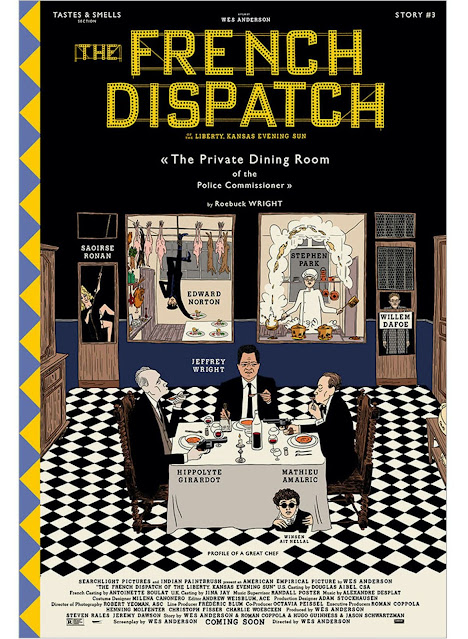
"The French Dispatch" Sent Straight to My Heart

Hi everyone,

I'm feeling inspired by the last-minuteness of this moment to hold myself to my goal of writing briefer posts about movies in support of the overall aim to write more and more often.  So here we go!

I'm happy to say that I've started the new year by not only watching a lot of movies (11!!) but also watching several very high quality, enjoyable movies.  The first such film was Wes Anderson's "The French Dispatch" (2021).

Perhaps surprisingly, for a few reasons I was hesitant to watch this movie.  I've been so emotionally burned out, and so wasn't sure I was prepared for the poignancy Anderson so deftly infuses into his otherwise so-twee-it's-eating-itself oeuvre.  I also feared being disappointed by one of my favorite directors, and due to aforementioned emotional burnout being ill-equipped to tolerate that potential disappointment.  

Nevertheless, and happily, Husband suggested watching it on the first day of the new year, and the gamble fully and heart nourishingly paid off.

I was grabbed immediately by the goddamn delight of this film.  The opening sequence immediately plunges the viewer into the precious and precise Anderson universe, as we watch skillful hands load and spin and load and spin a tray with all sorts of fiddly (and somewhat grotesque?) treats then trace an intrepid waiter's trek up an Escheresque series of stairs, ladders, and pulleys to take that tray to its final destination, all accompanied byAnjelica Huston's detailed narration of the titular publication's editor's biography.  It was like plunging into a warm, playful ocean -- I felt immediately embraced, blissfully submerged in a cheerfully, lovingly, and fastidiously curated parallel universe and buoyed by the voyage.

It's all the better that the film is set entirely in an imaginary French town, where the poised and hipsterly ennui that imbues so many of Anderson's movies informs the name of this movie's setting: Ennui-sur-Blasé.  As someone who desperately and achingly loves and misses Paris, I was grateful for a trip to an imaginary France that was just close enough to the real place I long for but not so close that it utterly broke my vulnerable heart.  If this film had been set in Paris, as more and more months slide by since my last trip there, I might not have been able to watch it.

Anderson honestly outdid himself with his casting for "The French Dispatch": the film features several Anderson film regulars, most notably Bill Murray, but also Saoirse Ronan, Tilda Swinton, Frances McDormand, Willem Dafoe, Adrien Brody, Jason Schwartzman, Bob Balaban, Owen Wilson, and thank God, Edward Norton (because where else do you get to see him anymore??).  He also manages to cram in wonderful performances by Benicio Del Toro and Jeffrey Wright (as a lovely and loving allusion to James Baldwin), as well as Christoph Waltz, Timothée Chalamet, Elisabeth Moss, Steve Park, and Henry Winkler for godsakes.  Honestly, I had to scroll the film's cast list on IMDB multiple times to make sure I'm not missing anyone because there are so many excellent actors and pitch-perfect performances in this movie (and I'm almost 100% sure I'm still managing to accidentally leave someone out).

I so thoroughly enjoyed this movie I was absolutely breathless at the end.  It is perhaps one of Anderson's best, most Anderson-y movies, in the best possible way.  If you like Wes Anderson, this is about as pure a version of his work as you can possibly get.  As a massive but not always satisfied fan of his work, it was a joy, a relief, and a welcome respite from this in so many ways wearying world.  I gave it an enthusiastic and grateful 5.

I hope you also love it!

{Heart}

Sunday, January 16, 2022

Antiracist Accountability and TYSG Mash-Up: Comedy Edition

Hi team!

Today I bring to you a post that in support of this year's resolutions around wellness, protecting space for enjoyment, and writing regular antiracist posts, PLUS another entry in our Terrible Year Survival Guide series.  I'm so efficient!

I've written before about how much I value humor as a coping strategy during dark times.  In an effort to consistently translate my love of humor into my everyday life, standup comedy has become a routine self-care strategy for me ever since I discovered several years ago that a streaming service I subscribe to has comedy stations.  I particularly listen to the stations that purportedly played the "comics of today," wanting to hear comics whose work I hadn't been exposed to before.

I quickly noticed as I first started listening to these stations, to my deep irritation and confusion, that the vast majority of the comedians the station was playing were straight white men.  In fact, after months of listening to this particular station, I only heard the work of 2-3 Black men, and literally ZERO women.  ZERO.

I'm not here to argue that straight white men aren't funny.  I acknowledge and affirm that funny straight white dudes do exist.  However, as I listened to very nearly nothing but straight white dudes, it definitely bummed me out how repetitively the content overall trended toward the toxic.

In comedy, there's this concept of punching up or punching down.  If you're punching up, you're using comedy to lampoon or take down people, institutions, or forces more powerful than you--you're David, and your target is Goliath.  If you're punching down, you're doing the opposite: you're bullying people, poking fun at those with less power than you.  In antiracist terms, you're using your privilege to uphold systems of oppression that harm others while shoring up your own social standing.  It's a really shitty, harmful, and tired way to do comedy.

As occupiers of the top of the racist, heteronormative, and sexist food chain we all live in, straight white male comics often find it all too easy to punch down.  Those jokes essentially write themselves, because they're the script we're all used to reading from.  Punching down is an easy, lazy way to get laughs from people who are just as invested in upholding the status quo as you are, just as it's easy and lazy to then claim that anyone who isn't laughing is just trying to take away your free speech rights.  (Because GOD FORBID anyone tell you your bullshit hackery posing as comedy is problematic as you're actively working to maintain systems of oppression that harm everyone more than you, right?!)  

As a result, like literally every corner of American society, standup comedy has a notoriously long-running problem with misogyny, homophobia (and transphobia), and racism that continues to this day.  One of the best ways to counteract that history is to turn our attentions to women, people of color, disabled people, and members of the LGBTQIA community for our comedy.

All this led to me channeling my indignant white lady powers by sending the following annoyed and stern "I want to speak to a manager"-esque email to customer service:

I love listening to comedy, among other content, through Pandora.  I am nevertheless really disconcerted that, after listening to the station for hours, not one single female comic has been included in Pandora's "Today's Comedy Radio" station.  In fact, the vast majority of the comics on this station are white heterosexual men.  The station occasionally includes bits from Hannibal Buress or Donald Glover, who are great!  They also identify in their comedy as straight men.

It goes without saying that there are tons of talented lady comics (not to mention comics of color and LGBTQ comics).  The "Today's Comedy Radio" station desperately needs a more diverse representation of "today's comedy," because as it stands it does not actually come close to representing the true diversity of comedy today.  Can you please address this lack of diversity and work to add content from a broader array of comics in this and other comedy stations on Pandora?

Thank you for your attention to this issue.

Weeks passed.  To my deepening consternation, nothing changed on my little corner of the streamable internet.  I therefore decided to double down on the Karen-but-hopefully-Karening-for-good energy with a second email, this time taking a slightly more irreverent (but still seriously exasperated) tone and focusing more pointedly on the lack of gender diversity in the service's content:

Hi Pandora,

I have been listening to your Today's Comedy Radio station for months.  I really love being able to listen to standup on Pandora, and I've enjoyed being introduced to comics I haven't heard of before.  However, it is REALLY disturbing and confusing to me that, in literally hours and hours of listening to this station, I have NEVER heard a woman comic's work.  Seriously?  Not one lady comic?

There are so many lady comics.  ESPECIALLY in "today's comedy."

Could you please address this weird oversight as promptly as possible?

Thanks so much!

And here's the thing: it worked!  I don't know if the internet radio bots actually listened to my scolding and pleading or if something else coincidentally shifted to finally add some seasoning to the comedy mix, but shortly after that second message, the content I was hearing dramatically diversified.  

In the years since, I've been introduced to some of my new favorite comics--almost all of whom, with only one or two exceptions, would not have been featured if that streaming service had stuck to its absurdly narrow and repetitive demographic of performers.  I'm so excited to share some of their work with you!

The videos and links below are of some of my favorite bits from each of the following comics.  Clicking their names will take you to their websites, where you can learn more about their upcoming shows, their past albums, and in most cases see more of their excellent, extremely entertaining work.

Without further ado!:

Praise the Lord! 
Trump's Spray Tan Guy
Atsuko Okatsuka*

The Wrath of the Cable Company
TuRae Gordon

Enjoy the laughs!

{Heart}

* = Atsuko Okatsuka has also been blowing up on, you guessed it, TikTok!  Check it out!