Sunday, February 26, 2023

Not Feeling "Notting Hill"

Hi again!

Let's see if I can actually write something quickly!

So there are a few themes in the movies I've been watching lately.  While this isn't an exhaustive inventory, I've been watching (including some rewatching) children's movies, heist movies, and some that I would broadly define as classics.  When I'm feeling not particularly interested in being challenged, I've been watching the occasional romcom.

That instinct, combined with Netflix's algorithm randomly REALLY pushing this movie hard in my immediately postpartum few days, led me to watch "Notting Hill" (1999).

...And I hated it.  A lot.  This is one of those rare movies I finished out of spite.

Here's why:

Quite simply, it's hard to believe these people like each other?

As William, Hugh Grant is peak Hugh Grant--compulsive yet unconvincing self-deprecation posing as charm, basically a walking British version of an American "aw shucks" and some purposefully unkempt--and yet perfectly kempt--hair as his whole personality.  Who is this guy?  He seems at once boring and exhausting.

Julia Roberts's Anna Scott is equally if not more poorly realized.  She is actually pretty awful to William, yet alternatingly also super into him?  Sounds like a toxic kink she could maybe work through in therapy.  But I guess we're supposed to believe an international celebrity could instantly fall for a random guy she has some dubiously cute banter with for 90 seconds before he spills alarmingly fluorescent orange juice all over her.

Truly this movie seems like a dude's embarrassingly improbable and poorly fleshed-out fantasy--that a beautiful famous lady would throw herself at a normy guy based on next to nothing--translated into film and thereby inflicted on audiences.

And also, why in God's name is this movie so long??  Especially when Anna and William spend comparatively little time together--SO little, with interactions that are at best a mixed emotional bag given Anna's rapidly oscillating behavior toward William--it's hard to wrap one's head around how this film crosses the 2 hour mark.

One of the rare potentially redemptive moments of "Notting Hill" is a dreamy continuous scene in which William walks through the markets of Notting Hill, at turns donning and doffing his jacket as the seasons change, trudging through rain and snow then basking in brilliant sunshine, passing seasonal goods for sale and neighbors whose lives progress, all to depict the unspooling of time between his contacts with Anna.  It would be a lovely and enjoyable passage if it didn't feel completely misplaced in what is otherwise a straight-ahead, not remotely cinematically inventive romantic comedy.

Finally, the pivotal "just a girl standing in front of a boy" line has aged into maximum cringe status.  This becomes especially true when William parrots it word-for-word to his assembled friends mere minutes after Anna delivers it to him in what feels like it was supposed to be a dramatic turn-about moment, rousing said friends in a romantic call to arms to help William reunite with Anna before she's out of his life forever.  The moment lands excruciatingly flat now.  I can almost hear the screenwriter congratulating himself for writing such a clever line and wanting to milk it for all it's worth, thereby justifying this bizarre victory lap.  Blech.

I gave this movie a 1.

{Heart}

Looking at "Luca"

Hello everyone!

I'm glad to share that my Second Child safely arrived and that we've all been settling into our lives together at home for a few weeks.  As with my last parental leave, I've had a nice amount of time to hang out with the baby and watch movies, which is delightful.  And also as with my last parental leave, the hands-free and brain-free time I have is humblingly limited.  I'm going to do my best to write as quickly as I can to ensure I write at least one thing this month.  I'm hoping to write more than that because there are several movies I'd like to comment on, but of course how that goes isn't entirely or even majority up to me.

Let's talk about "Luca" (2021).

I have several observations!  In no particular order because truly I don't know that I have the time to organize my thoughts coherently:

First of all, the animation of the Mediterranean landscape in "Luca" is arrestingly beautiful.  This stands in somewhat odd contrast to the rendering of the characters, who have a stridently cartoony--almost clamation-like--appearance.  When it's clear that some poor Pixar staffers almost certainly lost possibly hundreds of hours of sleep rendering hyper-realistic and stunningly gorgeous sea foam and giant, intoxicatingly fluffy clouds, it's hard to understand the choice to depict the characters in the film as so stylized.  It's like two separate teams of animators got very different art direction while making this film.

It's very possible and likely that I've become extra sensitized to the potentially negative attributes of children's media now that my oldest Child is at an age where we'll allow at least some tv and movie time, but even without being a parent I think I would have been struck by some of the darker elements in "Luca" in part because they seem so unnecessary.  Why is this film so violent, sad, and scary?

Some examples to illustrate my point:

  • One recurring joke involves characters jumping from a tall building for fun and proclaiming, “Take me gravity!”  They then plummet through a tree (which I guess we're supposed to assume mitigates their fall) and land in a slapstick manner, totally unharmed.  I realize this makes me a bit of a wet blanket, but seriously: isn't this quite dangerous to show little kids??  Could we not??
  • Uncle Ugo is TERRIFYING.  Why is he so terrifying?  And why does Luca need to punch him in the chest to restart his heart??  WHAT??
  • There's a decent amount of physical fighting that I found affronting.  Can we not model hitting people for children?  We can show that the villain is menacing in other ways, right?  We can show that friends disagree without coming to blows, right?
  • My beef with the portrayal of physical conflict doesn't even include the omnipresent possibly lethal threat of violence against the Luca, Alberto, and other "sea monster" kind.  It is revealed that every corner of Portorosso, the fishing village that Luca and Alberto visit, is adorned with either statues and images of dead ocean life or just straight up weapons of marine mayhem like sinister-looking harpoons.  Why not just nets?  I of course understand that there needs to be some tension to drive the plot of this movie, but why do characters in a children's movie need to be threatened with serious physical harm and possible death when the threat could simply be discovery or capture?
    • Sub-beef:  "Luca" asserts itself as an allegory simultaneously about the power and importance of bravely venturing out into the world in pursuit of your dreams and accepting people who are different from you.  What message does Portorosso's pervasive threat of existential annihilation send the "different" people addressed by this film's central metaphor?  Do those people need to be reminded of the risks to their safety an oppressive society comprises and the limits those risks place on their ability to achieve their dreams?  Ultimately this is a way in which these kinds of movie persist in centering members of dominant culture--by pleading with them to be compassionate toward people who are "different" from them using narratives that are terrorizing to precisely those "different" people.  Couldn't we figure out a way to invert that tired paradigm already?
  • Wait a minute, Alberto’s dad just LEFT him??  That plot point is completely heartbreaking, very disturbing for kids, barely explained, and never revisited.  What??
It just would be cool to make children's movies that are inventive, inspiring, and delightful without relying so much on these kinds of emotional tropes and plot clichés.  Children are capable of more emotional nuance and are in many cases more sensitive than these storytelling choices seem to honor.

Minor aside: Why does Disney hate Bruno so much?  What did Bruno ever do to people at Disney?

Less minor aside: Is Disney ever going to be capable of portraying a positive, accepting, and understanding parent-child relationship?  Their heavy reliance on parents being rigid, domineering, and clueless is so exhaustingly formulaic.

The overall strength of "Luca" is weakened by several perplexingly missed narrative opportunities.  Why don't we get to see the deep where Luca's parents threaten to banish him to?  Seriously, where is Alberto’s dad and what the hell is wrong with him that he abandoned his son?  For that matter, what's the deal with Giulia’s mom?  These oversights all end up making the story feel unfinished or underdeveloped, or perhaps like the filmmakers are just trying to set this film up for sequels.

From the first moments of "Luca", it was very striking to me how much this movie is basically just a somewhat adjusted version of "The Little Mermaid" (1989); both films hinge on the main character's acquisition of human stuff facilitating their growing interest in walking among humankind, which requires them to mask their true identity at their peril.  

But instead of fully moving past the main character's interest in material possessions and transitioning to an (admittedly problematic because AGAIN this is media for children) emphasis on achieving romantic love as we saw in "The Little Mermaid", "Luca" remains puzzlingly materialistic, and does so in a way that puts the film at war with itself.  By its conclusion (spoilers ahoy), Luca gets to go to school with Giulia and Alberto gets to remain in Portorosso with Massimo, his replacement father figure.  But the key driver for the film's plot is Luca and Alberto's aspiration to buy a Vespa, ostensibly so they could explore the world together.  This is revisited as the film ends when the boys finally acquire a scooter but then immediately sacrifice it so Luca can pay to go to school...?  Why couldn't they have just stayed together and followed through with their plan?  Again, this movie seems confused with itself.  (Also, is wanting a Vespa in this case a MacGuffin?  I've yet to fully grasp what that is.)

All this leads me to wonder: What happened to Pixar?  As I wrote in one of my earliest posts about "Toy Story 3" (2010), I previously took for granted that their movies were uniquely thoughtful and good!  While they've taken on some cool themes (like girls going through puberty) recently and I thought "Coco" (2017) was wonderful, it seems like their brand isn't as consistently high quality as it used to be.

All that said and all my critiques thusly catalogued, I still found "Luca" to be at least moderately watchable.  I therefore gave it a 3.

I also acknowledge that I have thoroughly and completely failed at writing a brief post here, which speaks to how deeply I love writing about films.  This struggle continues.  But at least I was able to get this post written today!

{Heart}

Sunday, January 29, 2023

Not Really Taking "The Taking of Pelham One Two Three"

Hihi,

One of the ways I'm clearly coping with/utilizing the ever-shortening time before Second Child is born is by writing.  I've been really glad to be able to dedicate some time to this every day for the last few days.  It's satisfying to start the year not only with several movies watched, but also with several entries written.  As my due date grows very near, it's possible that this is the last entry I'll be able to write before my new Child arrives, but of course at this point nothing is certain; if I can write more, great, if I don't obviously that's fine as well--I'll do my best to find time here and there to write once they're here.

I've watched a couple of movies throughout my pregnancy (including, for example, re-watched Martin Scorsese's "GoodFellas" (1990)) that have prompted my Husband to declare that I am experiencing what he terms "pregnancy bloodlust".  I have no explanation for this trend, although I'm sure Freud would have a squeamish-cluelessness-about-women-induced field day with it.  In any case, the most recent movie I watched to fit this pattern is "The Taking of Pelham One Two Three" (1974).

I chose "Pelham" because I was in the mood for a heist movie, which is a genre I've come to enjoy more especially since "Logan Lucky" (2017) and "Hell or High Water" (2016) demonstrated just how good these films can be.  In addition, I was guided to this film by: 

  • this list of the best heist movies, which listed the movie as #1,
  • my occasionally resurgent film student-y instincts to watch the "classics" (and by "film student" I mean "I took like 3 film classes in undergrad"), and 
  • its setting in assuredly classically gritty 1970s New York City (and my itch to chase, for example, "Dog Day Afternoon" (1974)).
With those criteria satisfied, this film seemed like a great option.

And here's the thing: Somewhat paradoxically, I've glad I watched this movie because it generally satisfied the rationale I just stated, and I also didn't think it was all that great.

Firstly, perhaps surprisingly, I didn't feel myself drawn into the potential thrill of the claustrophobic set-up of a bunch of innocent bystanders held captive by a coordinated team of thieves in the belly of New York's subway.  This might have been enhanced if the film had spent more time rounding out the characters trapped in the subway car while the clock ticked away on the thieves' ultimatum to the city to pay up or face their bloody consequences; instead, unfortunately, the captives were reduced to a variety of tropes likely meant to satisfy a contemporary audience's assumptions about the riffraff and non-English speakers who occupied New York City.

And that of course brings me to my second complaint: I know that I'm likely signing up for this when I watch a movie from this era, but I still feel affronted, annoyed, and puzzled by how compulsively so many movies from the '70s flesh out their dialogue with needless racism, homophobia, and sexism.  It is so grating, and on so many levels it pisses me off.  It pisses me off that casually expressing those kinds of attitudes in film was so acceptable and commonplace, that filmmakers were fine with only making movies for other straight white men and alienating and oppressing anybody else (and that the filmmaking industry was almost exclusively populated only by straight white men during this era and so much of the industry's history), and that screenwriters and everyone else involved in making movies during this period couldn't figure out another way to tell stories and add "color" to their scripts than relying on idle racist, homophobic, and sexist chatter often propped up by lazy stereotypes of the groups their language oppressed.

This pattern was persistent enough through "Pelham" that it watching it felt more akin to the much less satisfying for similar reasons "The French Connection" (1971) than 1974's "Dog Day Afternoon".  "The French Connection" sticks to rote centering of straight white dudes whose talk is peppered with the same kinds of oppressive talk as "Pelham" as it trails Gene Hackman's Jimmy "Popeye" Doyle's pursuit of heroin smugglers (although to be fair it does include that wild car chase).  Alternatively, "Dog Day Afternoon" tells the story of a heist conducted so one of the men involved can pay for gender affirming surgery for his partner, and is electrified by Al Pacino's intense and frenetic star performance as Sonny Wortzik.  The existence of this latter film proves that it was possible to make a somewhat more inclusive and therefore interesting heist movie in 1970s New York... not to mention that it is completely unsurprising that I apparently find it way more interesting when heist movies focus on the thieves and not law enforcement.

With all this taken into consideration, in rating this movie I balanced these considerations against the particular satisfaction I take in at least watching another film that further deepens my understanding of the history of American cinema, and especially a movie that gives me the opportunity to spend some time in a city I love even if it's not cast in a particularly flattering light.  I gave "The Taking of Pelham One Two Three" a 3.

{Heart}

Saturday, January 28, 2023

Take a Trip Back in Time to "The Automat"

Hello again everyone,

Let's talk about another movie I watched recently!

If you're in the market for a pleasant, engrossing, yet relatively low-stakes documentary, might I suggest:

The Automat (2021)

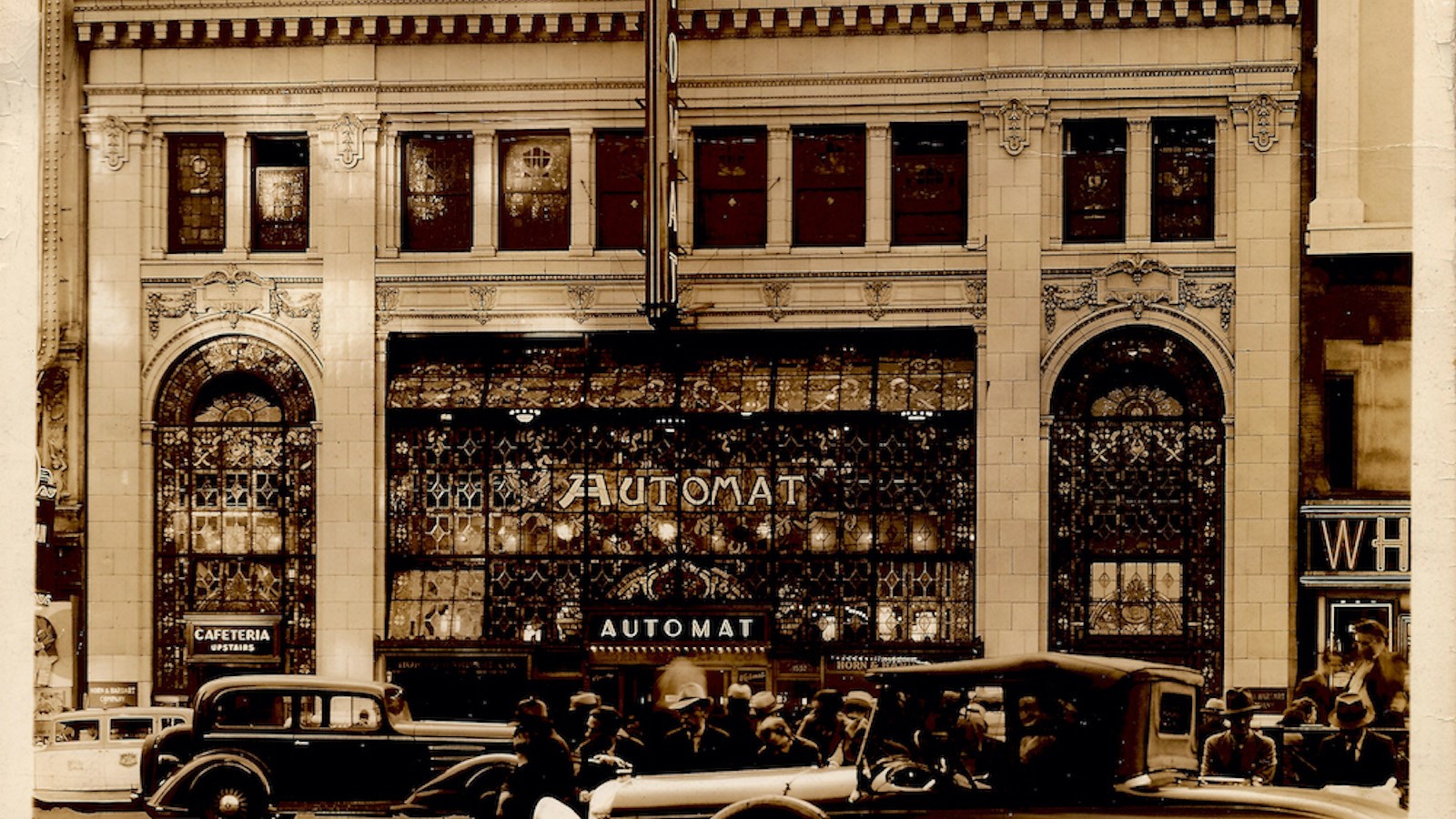
It might be hard to imagine that a feature-length movie on what appears to be a primordial and now-defunct fast food restaurant could truly be entertaining, but director Lisa Hurwitz delivers an extremely effective, comprehensive, and enjoyable film about a bygone and largely forgotten institution of a restaurant.  Located only in New York City and Philadelphia, Horn and Hardart's Automat restaurants were revolutionary for their time on many fronts; in fact, we learn from "The Automat" that the gleaming little nickel-operated doors unleashing treats upon the eager public were only the tip of the innovation iceberg for the chain.

First of all, to view automats as an early version of fast food restaurants is evidently a major mischaracterization that genuinely misses some of what made these eateries remarkable.  To start, the original restaurants were GORGEOUS, with gleaming marble and metal fixtures, high ceilings, and art deco decor.

Second, as essentially every talking head in the documentary enthusiastically attests, the food and coffee were apparently delicious, made from real ingredients well before the advent of food so chemically altered as to be unrecognizable.

But perhaps the most lovely aspect of automats was their commitment--with evident follow-through--to serving everyone, regardless of race, sex, or socioeconomic class.  The beautiful interiors and high quality food at a Horn and Hardart attracted, it seems, everyone, and because of the affordability of the offerings everyone could actually afford to dine there.  But beyond that, the chain had a stated aim to welcome everyone; patrons even shared tables with strangers during busy times, and no one was to be hustled or harassed out of the restaurant even if they lingered for hours.

As the film charts the rise and decline of Horn and Hardart over almost the entirety of the 1900s, the sincere affection expressed for the restaurants by the often very famous people interviewed (including Mel Brooks, Ruth Bader Ginsberg, and Colin Powell) invites the audience to join in gentle, wistful nostalgia for a dining experience we may never have shared ourselves.  It's a remarkable accomplishment for a documentary that, at first glance, was just about a humble restaurant from the past.

I gave this movie a 4.  You can learn more about it here, or stream it on HBO Max.

{Heart}

Friday, January 27, 2023

Adventuring Back into the World with "Puss in Boots: The Last Wish"

Oh hello!

I mentioned in my recent resolutions post that I've happily already had the pleasure of watching a bunch of movies in 2023.  I'd love to write a few posts about some of those movies before new Child is here, so to start let's talk about one of them!

Yesterday I went back to a movie theater for the first time since the pandemic began.  It was at once such an everyday-seeming thing and also an incredibly meaningful thing, especially since I was able to go to one of my two favorite local theaters.  

This is one of the two theaters from which I bought movie tickets the day the local COVID-19 shutdowns began because I foresaw the possibility that the shutdowns would be much longer than the initially projected two weeks, and I was terrified those beloved theaters would close down for good.  Of course one or two extra tickets sold wouldn't make a life-or-death difference for a movie theater, but these institutions are so precious to me and I wanted them to know that their patrons would look out for them as best they could.  And here this theater is, having survived.

And what fine cinematic masterwork did I choose for my first foray back into the movie-watching public?

None other than:

Puss in Boots: The Last Wish (2022)

When deciding what to see, there were three factors I considered:

  1. Was the movie playing at one of the two aforementioned theaters? 
  2. Was the movie playing at a time that accommodated my dog's grooming appointment?
  3. Was it a movie I was in the mood to see given the extremely close proximity to my forthcoming Child's birth?

I've essentially already explained why criterion 1 was important: After almost three full years of longing to return to movie theaters, of course I would want to go to one of my two favorites.

The second was simple practicality: In addition to partaking in cinema, yesterday was the grand crescendo of our nesting-induced cleaning of all the things, which included orchestrating a simultaneous professional deep clean of our house and professional deep clean (aka grooming with deshedding) of our beloved dog.

Care of Hyperbole and a Half

Everything is now SPARKLING.

And finally, the third criterion speaks to the fact that while there are movies currently out that I would be very tempted to see under different circumstances, I didn't want to risk putting myself in a weird emotional headspace *right* before having a baby.

So I saw "Puss in Boots: The Last Wish", because it checked those three boxes, had such remarkably high ratings that it was almost perplexing, and had been affirmed to be a good movie by a friend.

And: I thought it was delightful!  It's funny and charming, and the vocal performances are very well-delivered.  The animation overall is really great, including action sequences have an appealingly slightly herky-jerky comic book feel to them reminiscent of sequences in "Spider-Man: Into the Spider-Verse" (2018).  The movie has overall sweet and healthy messages about the importance of friendship and chosen family, trust, and overcoming fears.  The cast is diverse and the script incorporates a decent amount of Spanish, and that inclusivity further enhances the story.  The film is paced well and packs in lots of fun twists and turns for its relatively brief (and therefore both child-friendly and punctually-picking-up-dog-from-groomer-compatible) runtime of 1 hours and 42 minutes.

I should also probably note that I haven't been a dedicated viewer of movies in the "Shrek" (2001) franchise, having only seen the first and second (2004) movies, so it's perfectly possible that my relative naiveté about these movies influences how I experienced this one.  I almost certainly missed allusions to events in the previous Puss in Boots movies (2011 and 2012), for example.

I have only two complaints with the latest "Puss in Boots": First, it's a bit scary for children.  The premise of this film is that Antonio Banderas's titular Puss is down to the last of his nine lives, and is being actively pursued by Wagner Moura's bounty hunter (or is he?) Big Bad Wolf.  In stark contrast to his typical bravado, Puss experiences these encounters with sheer and palpable terror.  These moments are very effective for their drama and emotional impact, but so much so that I would be concerned about very little kids watching this movie.

My second complaint is an age-old pet peeve of mine about children's movies that make jokes that are not intended to be understood by or appropriate for children.  I'm remembering this was a factor that irritated me about the original "Shrek", so I'm not surprised that this trend continues to some extent in the franchise's newest chapter.  To be fair, there aren't a ton of these kinds of jokes in "The Last Wish" (there are a few bleepings of the business end of the term "bullshit", for example), but to me these moments always beg the question of why?  Why can't you just write jokes that everyone in the audience can enjoy, especially when you are explicitly making a children's movie?  To do otherwise just seems cheap, lazy, and a bit mean-spirited or disrespectful toward kids--the film equivalent of clapping your hands over a child's ears so they can't hear a spicy segment of a conversation between adults.  Who wants that when you're watching a movie that's supposed to be for you?

All that said, this was overall a very successful and charming movie, and I'm glad it was a part of my post-pandemic transition more fully into the world.  I gave the film a 4.

{Heart}